Pack for the cold you don't expect · 2026
Rinjani packing list: summit-night layers, rim cold, and what we already carry for you.
The mistake people make is over-packing things we provide and under-packing for the cold. Here's exactly what to bring, what to leave, and what we carry up so you don't have to.
What we already carry up
Start here, because half of what packing lists tell you to bring, we already carry. Don't double up.
Don't pack a tent, a bag, or a stove. Pack the layers. That's the part only you can get right.
Summit-night kit, layer by layer
This is the section to get right. You leave camp around 2 a.m. into wind and cold, and you dress in layers you add and shed as the sun comes up. Bring all of it.
Three layers, worn together at 2 a.m.
The bits that go numb first
You'll put on every layer you brought at 2 a.m., and take them all off by 9.
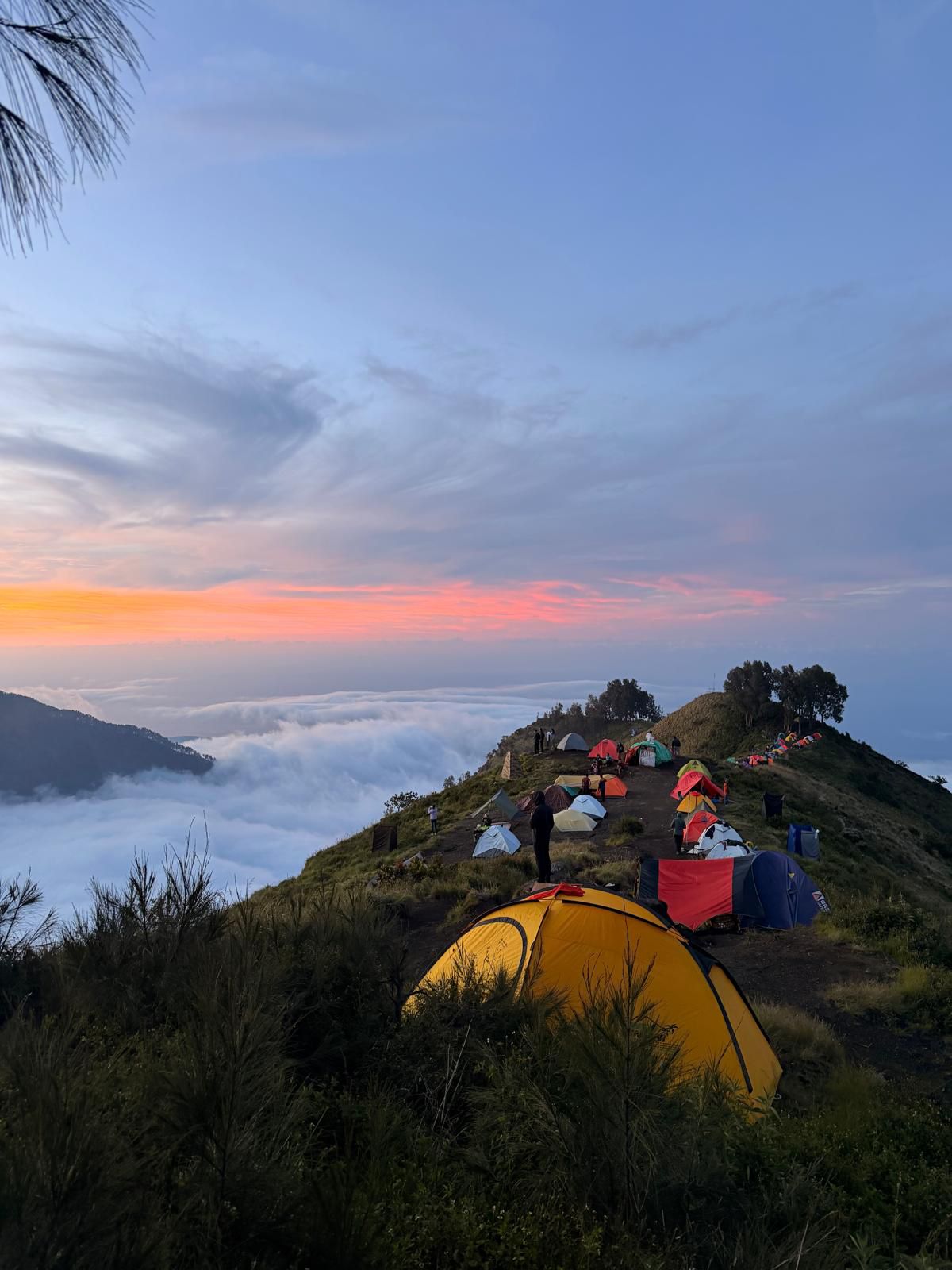
Sleeping warm at the crater rim
These are operator estimates, given as typical ranges, not guarantees. Nights up there vary a lot, so pack for the cold end and ask Pak Wil what he'd bring for your month.
We give you a 3-season tent, a mat, and a bag warm enough for a normal rim night. Pak Wil has no comfort rating from the supplier, so we won't print one, but the bag handles a normal night at the rim on its own.
If you know you sleep cold, the fix is small: bring a thermal base layer to sleep in and a beanie. That's the difference between a rough night and a fine one. The coldest nights of the year are July to August.
Footwear: boots or trail runners
There's no single right answer here, and anyone who tells you there is hasn't done both. Here's the honest trade-off.
Hiking boots
Ankle support on the loose scree near the summit, and on the long descent when your legs are tired and your footing gets sloppy. Stiffer, warmer, heavier.
Best if you're not a confident downhill walker, or you've rolled an ankle before.
Trail runners
Lighter and quicker, and plenty of experienced trekkers do Rinjani in them. Less ankle support, so more is asked of your own balance, especially on the scree.
Best if you're experienced on trails and your knees and ankles are good.
Whichever you pick, the Senaru and Torean descents are long and steep, hard on the knees either way. Break your shoes in before you fly; the summit is no place to discover a hot-spot. If you'd rather not travel with boots, we rent trekking shoes in Senaru for about IDR 100,000 to 150,000.
Daypack vs porter bag
Two bags: a small daypack on your back, and a main bag the porter carries. The trick is packing them so you're never reaching for something that's an hour up the trail.
On you · daypack
- Water for the stretch ahead, and your summit layers
- Headlamp, snacks, sunscreen and a hat
- Camera or phone, and your valuables: passport, cash, cards
- A light rain layer, just in case the cloud builds
Porter carries · main bag
- Your spare clothes and your sleep base layer
- The change of clothes for after the summit and at camp
- Toiletries, charger, anything you don't need while walking
- The tent, mat and sleeping bag, those are ours, already up there
Pack your main bag so the porter isn't carrying your day-essentials uphill and back down again, and so it stays within our porter load limit. We keep loads under the park's 30 kg limit for a reason, lighter where we can.
What to leave, and what to rent in Senaru
You don't need to buy a full kit for one mountain. Bring the layers; the bulky stuff you can sort here.
Drop it at our office
The wheelie suitcase, your clean clothes for after the trek, and anything you don't want on the mountain: leave it at our office in Senaru and pick it up when you come down. We store it safely for the whole trek.
Rent it in Senaru
If you've left kit at home, you can rent it from us in the village rather than carry gear across Indonesia for one climb. Rough 2026 rates per item: trekking shoes IDR 100,000 to 150,000, a jacket IDR 50,000 to 100,000, a day backpack IDR 50,000 to 100,000, trekking poles IDR 60,000 a pair, a headlamp IDR 20,000.
Tell Pak Wil before you arrive what you're missing, and he'll tell you whether to pack it, rent it, or leave it to us.
Tell Pak Wil your month and he'll confirm exactly what we provide for your route, so you only pack what's actually yours to bring.
Already booked? Forward this list to your trek-mate. He answers his own WhatsApp, 07:00-21:00 WITA.
WhatsApp Pak WilQuick packing questions
Do I need to bring a sleeping bag?
How cold does it really get?
Boots or trail runners?
Can I leave my big bag somewhere?
What if I forgot something? Can I rent it in Senaru?
“The people who suffer up here aren't unfit. They're cold. Pack for the wind, not the forecast.”
Pak Wil, Senaru
Last reviewed by Pak Wil: 2 June 2026