The honest version, not the highlight reel · 2026
What Rinjani summit night actually feels like at 2 a.m.
Nobody books the trek for summit night, but it's the part you'll remember and the part that makes people want to quit. Here's the real account: what the hours feel like, where it gets hard, and why turning back is never the failure people fear it is.
Why summit night is the hardest part of Rinjani
Not because of the distance or the height, but because of what it asks of your head in the dark and the cold.
The summit push is the only stretch of the trek that's genuinely, consistently hard. You leave camp around 2 a.m. in the cold, by headlamp, onto a slope of loose volcanic scree, and the scree is the whole problem. For every two steps up, you slide one back. It's slow, it's relentless, and it goes on for hours.
What makes it hard isn't your legs. It's that it's dark, you're tired, you can't see the top, and your brain starts negotiating with you. The fitness gets you most of the way up the mountain; summit night is mostly a head game, and that's the part no training plan prepares you for.
It's not your legs that quit up there. It's the voice that says you can.
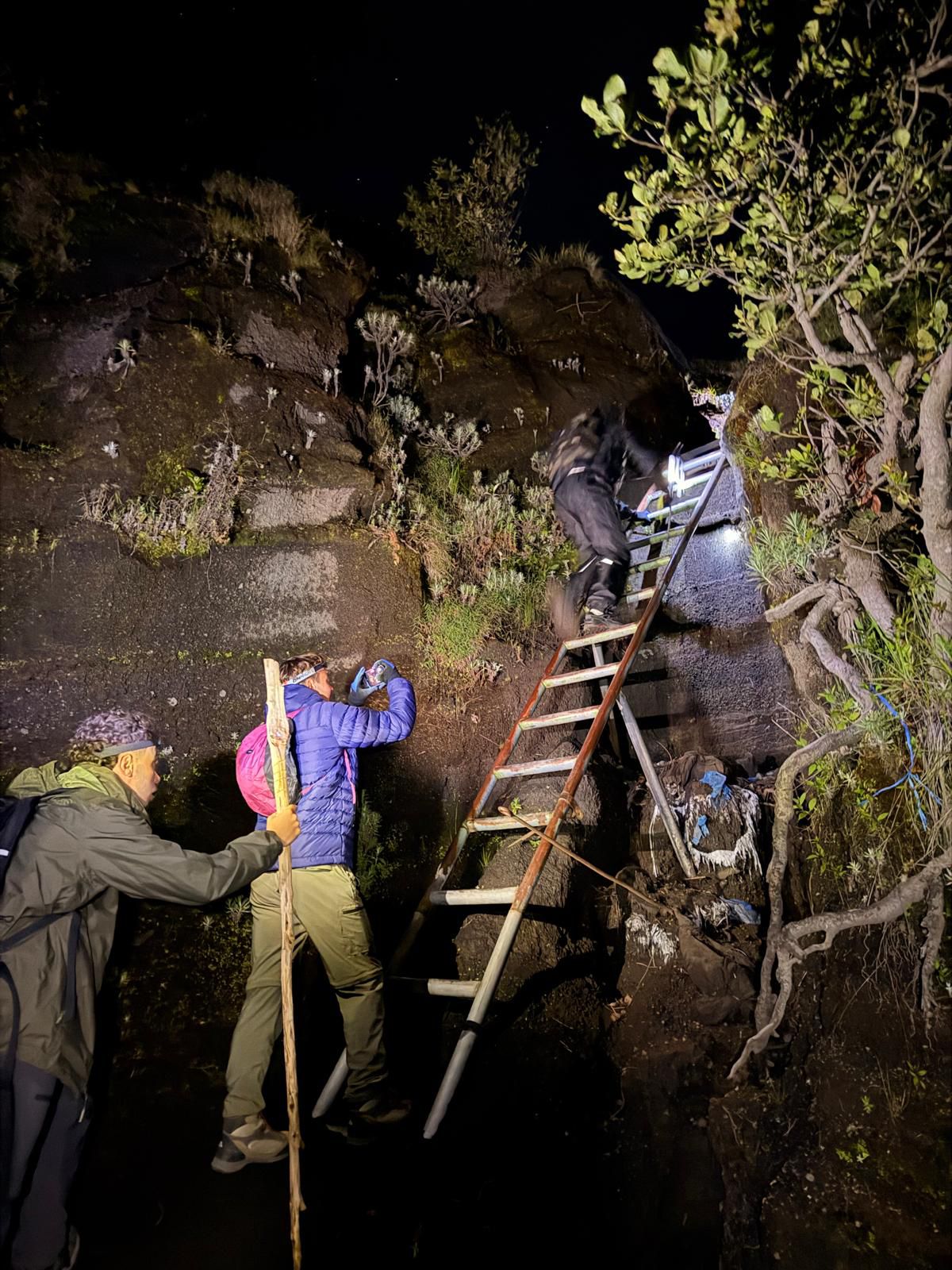
2 a.m. to sunrise, as it actually goes
Knowing the shape of the night is half the battle. When you know what each hour feels like, the hard part stops being a surprise, and a surprise is what breaks people.
The clock is rough, your night may run faster or slower, but the shape is always this: a cold start, a long grind, false tops, then a sunrise that resets everything.
The scree section everyone underestimates
If one thing on this page sticks, make it this. The scree is the reason summit night is hard, and the reason people turn back.
The final climb to the summit is loose volcanic gravel and sand, not rock, not a path. It gives way under every step. You push up and the ground slides you back down, so a slope that looks like a half-hour climb takes two or three times that. There's no technique that makes it easy; there's only patience.
The mistake is fighting it: charging hard, burning out, then standing exhausted while the cold sets in. The trick is the opposite: short steps, a steady rhythm, kick the toe in, and accept that slow is the pace. People who make the summit aren't the strongest. They're the ones who didn't panic at how slow it felt.
Slow isn't failing on the scree. Slow is the only thing that works.
What our guides do when you want to quit
The want-to-quit moment is so normal it's almost scheduled, somewhere around 3 a.m. for most people. Here's how a good guide carries you through it.
Most people who think they'll quit at 3 a.m. are standing on the summit at sunrise. That gap is the guide's whole job.
Tell Pak Wil what worries you about summit night and he'll tell you straight whether a longer route makes it easier, or just gives you more margin.
He answers his own WhatsApp, 07:00-21:00 WITA. He'd rather you pick the right route than the brave one.
WhatsApp Pak WilTrekkers who turned back, and what they say now
Turning back is not failing. It's a normal, sensible thing that happens on this mountain. We'd rather print real turn-back stories than invent them, so the verified ones go here.
Plenty of people don't reach the summit, and almost none of them regret the trek. The view from the crater rim at sunrise is extraordinary on its own; the lake, the camp above the clouds, the whole experience holds up completely without the final ridge. People who turn back at 4 a.m. and watch the sunrise from lower down still describe it as one of the best things they've done.
“Very few of my guests turn back. And the ones who don't reach the summit almost always come down glad they came.”
That is Pak Wil's honest experience, and here is why it holds. The whole way up already gives you the views: on a clear morning the panorama from the crater rim camp at Pelawangan is spectacular on its own. Between that, the people you walk with, and the challenge you got through, most climbers who don't summit still call Rinjani one of the best things they have done.
Picking a route that matches your headspace
Two things help: a few mental tricks the guides swear by, and choosing a route that fits how you handle hard things, not just how fit you are.
The tricks the guides use: count steps to a number and start again. Walk to the next rock, then pick the one after. Don't look up at the top, look at your boots and the patch of light in front of them. Eat something small even when you don't want to. None of it is clever; all of it works at 3 a.m.
The bravest choice isn't always the hardest route. Picking the one that matches your headspace is how you end up glad you came.
Summit night, quickly
How long does summit night take?
Why is it so much harder than the rest of the trek?
What if I want to quit halfway up?
Is turning back a failure?
Does a longer route make summit night easier?
"I tell everyone the same thing at the wake-up: you don't have to want it now. You just have to take the next ten steps. The summit takes care of itself."
Pak Wil, Senaru
Last reviewed by Pak Wil: 2 June 2026